
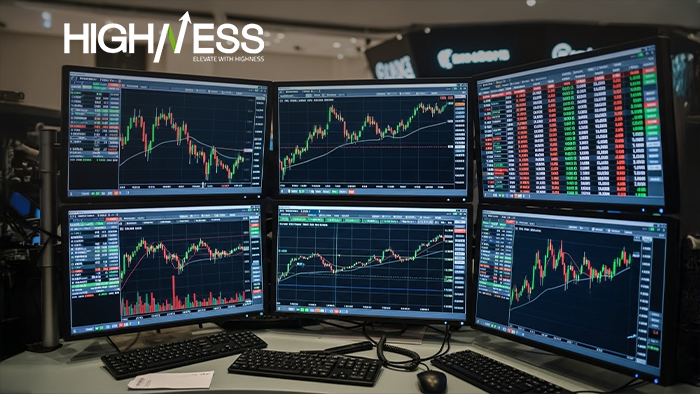
Financial markets are the backbone of the global economy. They are the place where buyers and sellers meet to trade various types of assets, such as stocks, cryptocurrencies, commodities, and foreign currencies. Since understanding how these markets operate is a key step before starting to trade, this article provides a simple and clear explanation of how they work, what drives them, and the role they play in the economy.
Financial markets are organized environments where assets are traded between investors and traders. Their main purpose is to facilitate the transfer of capital, enable investment and funding, and help manage financial risks.
The core mechanism of any financial market is the balance between supply and demand:
When buyers outnumber sellers, prices rise.
When sellers outnumber buyers, prices fall.
This constant interaction creates the price movements monitored by traders.
Markets operate through several key participants, each with a different role:
Investors: Buy assets for the long term.
Traders: Focus on short-term price movements.
Financial institutions: Such as banks and investment funds.
Brokers and platforms: Provide access to markets, such as the Hynes trading platform.
Together, they create an active and efficient trading environment.
Financial markets are divided into several categories, including:
Stock market: Buying and selling shares of companies.
Forex market: Trading foreign currencies.
Commodities market: Gold, oil, and metals.
Digital assets market: Bitcoin, Ethereum, etc.
Each market has its characteristics but operates under the same basic principles.
When a trader clicks “Buy” or “Sell,” the process goes through several steps:
Sending the order through the platform.
Matching the order with others in the market.
Executing the trade at the current or specified price.
Recording and adding it to the trader’s open positions.
Advanced platforms—like Hynes—use high-speed technology for fast and accurate execution.
Prices are driven by several main factors:
Economic news: unemployment data, interest rates.
Financial announcements: corporate earnings reports.
Geopolitical factors: crises, tensions, government decisions.
Natural supply and demand in the market.
Understanding these drivers helps traders make informed decisions.
Traders rely on two forms of analysis:
Technical analysis: Charts, patterns, indicators.
Fundamental analysis: Economic data and news.
Combining both provides a clearer view of trading opportunities.
Facilitate investment and funding.
Support economic growth through liquidity.
Create trading opportunities for short- and long-term investors.
Without financial markets, today’s global economy wouldn’t function as efficiently.
Understanding how financial markets work is the first step for any aspiring trader. They are a dynamic system driven by supply and demand and influenced by economic and geopolitical factors. With advancing technology, accessing these markets has become easier than ever through professional platforms like Hynes.
Discover why over 25.000 live trading accounts trust Highness, and join the community of successful traders today.


 KU
KU